A Closer Look at Kindness

“Since God chose you to be the holy people He loves, you must clothe yourselves with tender-hearted mercy, kindness, humility, gentleness, and patience.” (Colossians 3:12 NLT)

One of the definitions of kindness in Strong’s Concordance that caught my attention is “benignity.” Not a word you see every day, huh? Yeh, I had to look it up. Of course, I recognized the “benign” part, because my son had cancer, but I couldn’t reconcile “cancer” with “kindness.” So, I dug a little deeper, and now believe it’s the perfect word to describe “kindness.”

Think about it. What’s the kindest word you can hear if you’ve had a biopsy and suspect cancer? “The biopsy was benign!” Whoa! Can I hear a HALLELUJAH!

When I think of the word “kindness,” I think of Jesus. He’s kneeling in the dirt doodling while a woman’s life, who was caught “in the very act of adultery,” is hanging in the balance. He’s not showing any anger or any kind of demeaner that would tip anyone off that He’s the Creator of the universe. But He makes a statement that puts perspective to the situation. “All right, but let the one who has never sinned throw the first stone!” “BOOM!” “GOT YA!”

Can you hear the rocks dropping? Can you hear the shuffling of guilty feet scurrying to find some place to hide their shame? How like us to stone someone, if for no other reason than to turn attention away from ourselves.
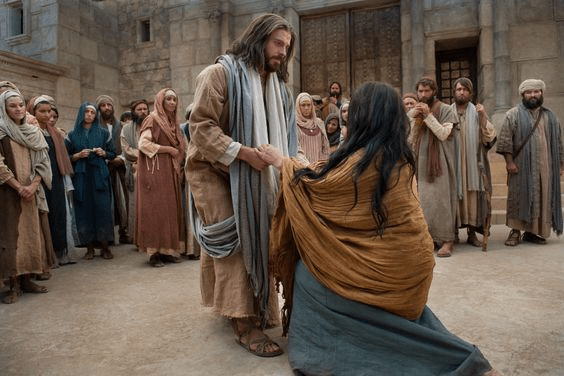
And here’s the woman, lying in the dust, waiting for the other shoe to drop. Expecting anything but what she heard: “Where are your accusers? Didn’t even one of them condemn you?” To which she sheepishly responded, “No, Lord.”

Then Jesus shared the most healing, life-transforming, benign, words that could have possibly been spoken in that setting: “Neither do I. Go and sin no more.” Jesus is the epitome of gentleness, kindness, humility, yet, at the same time, of power, strength, and courage.

If you’ve ever been in the proverbial “dust,” ashamed, frightened, hopeless, desperate, and in utter despair, like I have been, you know there’s no greater kindness. To be forgiven and given another chance to live right and honor the One who forgave you is liberating.

We can debate all day whether the lady’s life changed, but you’ll never convince me she’s not going to meet us in heaven with the most beautiful smile anyone could ever imagine. Forgiven people are kind, loving, caring, forgiving, not because they think they’re better than everyone else, but because they know they’re not.

Kindness restores dignity, lifts moods, and gives hope. It’s like a sip of cold water on a very hot day. It’s the soothing presence of warm water after being caught in a driving rainstorm on a chilly evening. It’s the feeling of safety and security as you’re enveloped in the arms of the one you love more than you love your own life. It’s the sense of security you have when you realize you’re going to heaven, not because of anything you’ve ever done to deserve it, but because of the kindness of a Savior who loves you more than He loved His own life.

As God’s beloved children, we need to practice kindness, if for no other reason than to give expression to our love for the One who loved us when we couldn’t love ourselves; when we couldn’t lift our head; when our heart was breaking, knowing we didn’t earn or deserve His love, forgiveness, or kindness…and we never will!

Blessings, Ed 😊

A Closer Look at Patience

“By standing firm, you will win your souls.” (Luke 21:19 NLT)

Patience is one of those virtues that you really hope one day you’ll have, but you’re a bit afraid to ask the Lord to give it to you. We’re like the man who, in his frustration, shouted to the Lord: “Okay, Lord, I get it. So, give me patience and give it to me RIGHT NOW!In wisdom, the Lord doesn’t work that way.

Remember, we’re looking at the fruit of the Spirit, seeking to identify areas of our lives where we can allow the Lord to “search us,” as King David suggests in Psalm 139:23-24. We’ve looked at love, joy, and peace, and today we’ll shift the spotlight of God’s Spirit onto patience.

In the King James Version of the Bible, Galatians 5:22 translates the word the NLT and other versions translate as “patience” as “longsuffering.” On many levels that’s a much more descriptive word, because it means – “endurance, constancy, steadfastness, perseverance, forbearance, slowness in avenging wrongs.” (Strong’s)

The context of the verse above is Jesus giving His disciples, and us, insight into how things will be in the last days. He speaks of persecution on an unparalleled level; betrayal, even by those closest to us; everyone hating us because we’re Jesus followers; and other things descriptive of very difficult and frightening times.

In the early verses of Romans 5 Paul speaks of our faith and peace that God gives us, and the great privilege which is ours to be God’s children and to look forward to sharing in His glory. Then in verse 3ff he says: “We can rejoice, too, when we run into problems and trials, for we know that they help us develop endurance (patience). And endurance develops strength of character, and character strengthens our confident hope of salvation.”  

In some ways I believe we give a prospective Jesus follower a faulty vision of what life in Christ is supposed to look like when we don’t let them know it takes persistent effort to grow in our likeness of Jesus. Yes, of course, there are rewards now, but the lion’s share of our rewards will come when we meet Jesus after this life ends.

Photo by Abhinav Goswami on Pexels.com

We want to have our proverbial cake and eat it too. We want assurance of heaven without any effort to grow in our likeness of Jesus. We want salvation without sanctification; we want wholeness without holiness; we want character without commitment; we want to bear His name without bearing His scars.

We don’t like verses like Luke 14:26 when Jesus said: “If you want to be My disciple, you must hate everyone else by comparison – your father and mother, wife and children, brothers and sisters – yes, even your own life. Otherwise, you cannot be My disciple.” What does that look like?

It looks like putting Jesus above all else. It looks like enduring hardships when the future is unclear; it looks like standing strong when life is an uphill battle; it looks like trusting God when money is short, and energy is low. When tempers flare and anger is simmering; when love is a struggle and pain is real. It looks like yielding to His will when it doesn’t seem to make sense.

Life as a believer can be very difficult, but we can’t lose sight of the fact that we put God first by loving Him and others more than we love ourselves. In the above verse, Jesus isn’t telling us to hate anyone, especially not our family. The easiest way to think of it is to substitute the words “love less” in place of “hate.” Keep your love for Jesus above all others.

Patience grows out of obedience, especially when it’s hard. That’s the price we pay when we love Jesus supremely and desire patience.

Blessings, Ed 😊

A Closer Look at Peace

“Because of God’s tender mercy, the morning light from heaven is about to break upon us, to give light to those who sit in darkness and in the shadow of death, and to guide us to the path of peace.” (Luke 1:78-79 NLT)

There are more than 100 references to peace in the New Testament and, like the term “love,” there are at least four distinct Greek words that are translated “peace.” In the above verse and in Galatians 5, where it refers to “peace” as one of the fruit of the Spirit, the term can be translated like we often think of peace, as the absence of conflict, whether in a national or personal sense.

But unlike the other terms, this word has reference to the Messiah’s peace, “the tranquil state of a soul assured of its salvation through Christ, and so fearing nothing from God and content with its earthly lot, of whatsoever sort that is.” (Strong’s)

Peace, in this context, isn’t simply something we receive from God, it’s what we offer to others in His Name. Why is that so important? Jesus said in Matthew 5:23: “So if you are presenting a sacrifice at the altar in the Temple and you suddenly remember that someone has something against you, leave your sacrifice there at the altar. Go and be reconciled to that person. Then come and offer your sacrifice to God.”

The point is, God doesn’t simply give us peace with Him, He engages us in the ministry of being agents of peace with and for others. Peace isn’t only an emotion or a sense of calmness and satisfaction, it’s a ministry and a mission we teach with our lives.

Some of the terms translated “peace” mean to keep quiet when the temptation is to speak. The picture one of the words paints is of a muzzle for an animal. If God’s Spirit is living in us, He will enable us to keep our tongue harnessed, thus preventing us from stirring up trouble and adding fuel to the proverbial fire.

James reminds us in chapter 3:6: “And the tongue is a flame of fire. It is a whole world of wickedness, corrupting your entire body. It can set your whole life on fire, for it is set on fire by hell itself.” Some of the words interpreted “peace” mean “to hold your peace,” which can also be translated: “keep still or remain silent.”

In thinking about this whole subject of peace, the Lord reminded me of the many times I could have enjoyed a much greater level of happiness and peace in my marriage if I’d just kept my mouth shut. James writes in 1:19: “Understand this, my dear brothers and sisters: You must all be quick to listen, slow to speak, and slow to get angry.”

The presence of God’s Spirit produces fruit in our lives that we can’t produce in ourselves. That’s why it’s called the fruit OF THE SPIRIT! How many times have you heard or said: “I got so mad! I couldn’t keep my mouth shut.” We just need to give the Spirit permission to “muzzle” us before that happens.

When I was first in ministry an Elder called me and reamed me out for not doing something he’d asked me to do. By God’s grace, I remained silent. Finally, he asked me: “What do you have to say for yourself?” To which I replied, “Nothing. I’m wrong and I apologize. I’ll make it right.” We became good friends from that point forward.

Before we can be at peace with others, to God’s honor and glory, we have to be at peace with ourselves, allowing God’s Spirit to have complete rule and reign in our lives. Be patient with yourself. It takes time.

Blessings, Ed 😊

A Closer Look at Joy

“The Kingdom of Heaven is like a treasure that a man discovered hidden in a field. In his excitement, he hid it again and sold everything he owned to get enough money to buy the field.” (Matthew 13:44 NLT)

Have you ever wanted something really badly? How did you feel when you got it? Mixed emotions?

When Paul listed the “fruit of the Spirit,” on some levels, these are unique gifts, and our responses to what God is developing in us over time is varied. Yes, the Spirit fills us, and we get all of Jesus when we repent and yield our life and allegiance to Him. But I believe it’s safe to say, He doesn’t get all of us.

Some of the “fruit” ripens more quickly, while others take time. Joy is used about 60 times in the New Testament and many times refers to gladness brought about by something God has done or is doing – like when John the Baptist, while still in his mother’s womb, jumped for joy when he heard Mary’s voice. Or the shepherds response when the angel brought them news of Jesus’ birth.

It speaks of uncontainable enthusiasm. Like how fans respond to their favorite team scoring the winning point in the last second of the game. It’s more than happiness, it’s an exuberance that resurfaces every time you bring it to remembrance.

That’s what Jesus was addressing in the parable above. The unbridled excitement when the man, after selling everything he owned to get enough to buy the field, finally hears the words – “it’s yours!” Others don’t understand. Why would someone be so giddy about buying a field? They don’t know about the treasure!

It’s like that with us. We hear about Jesus, and it piques our interest. So, we investigate further and discover that He is the Treasure we’ve been searching for all our lives. So, we “sell” everything that once held value. Family members and friends think we’re nuts. “It won’t last!” they say. Or “They’ll get over it!” But we can’t.

It’s like Paul in Philippians 3:7 when he wrote: “I once thought these things were valuable, but now I consider them worthless because of what Christ has done.”

Photo by kelvin octa on Pexels.com

Joy, in the context of who Jesus is and what He’s done for us, is more than an emotion, it’s a mindset. It’s an attitude of gratitude to which we can never give full expression. The closest thing to which I can liken it is the birth of your first child. How can you adequately give thanks for such a treasure?

It’s delight that deepens and grows over time. It’s what Peter was trying to express when he wrote in 1 Peter 1:8: “You love Him even though you have never seen Him. Though you do not see Him now, you trust Him; and you rejoice with a glorious, inexpressible joy. The reward for trusting Him will be the salvation of your souls.”

We went around our circle of volunteers at church answering the question, “For what are you most grateful this morning?” An elderly man with a quivering lip said: “I asked the Lord to heal my 50 year old son’s cancer, and He did!”

That deep sense of gratitude that moves us to the core of our being; that draws from us an appreciation that words cannot adequately express; that sense of awe that fills our hearts and minds when we think about what it will be like to worship at the feet of our Savior in heaven – these are how I think of the joy I have in knowing, loving, and serving my Savior.

Blessings, Ed 😊

A Closer Look at Love

“Jesus replied, ‘You must love the Lord your God with all your heart, all your soul, and all your mind.’ This is the first and greatest commandment. A second is equally important: ‘Love your neighbor as yourself.’ The entire law and all the demands of the prophets are based on these two commandments.’” (Matthew 22: 37-40 NLT)

Is it safe to say that our understanding and concept of love is far different than God’s? How can we even begin to understand a love that offers His only Son to bridge the gap between sinful human beings and Himself? How can we possibly conceive of a love that not only doesn’t demand His own way, but ignores His own way in favor of the way of His Father?

We whine about someone parking in “our” parking spot or sitting in “our” seat at church or feel obligated to contact the church office because someone wasn’t dressed very nicely, and they smelled. We love the stories the missionaries tell of the impoverished people whose lives were positively impacted by our churches giving, but we’re often too busy to volunteer to serve the impoverished in our own city.

Sometimes I literally cry because of the hardness of my heart in comparison to the picture of Jesus’ life painted for us in Scripture. His love knew no bounds. When someone needed Him, He responded.

Photo by Timur Weber on Pexels.com

Have you ever wondered why so few miracles occur today in America compared to all the miracles that were done in the New Testament, not only by Jesus, but by His followers? Even in other parts of the world today, it’s much more common to see and hear of God’s power being manifested in miraculous ways.

God’s love hasn’t changed. His healing virtue is just as real today as it’s ever been. His availability to touch and change lives hasn’t been altered. So, what’s changed? And I’m not referring to our dark, lost world, I’m talking about me! A professing believer who too often loves myself more than I love God or others. I attend and give and serve and worship and cry and pray – but my love too often is an inch deep and a mile wide.

There’s a man in my Men’s Group who volunteers in the church office every week. He inputs information for the many new people the Lord is sending us and makes calls to follow up with them. He volunteers on Sunday to serve and is often involved in other ways throughout the week. He’s a busy man. Yet, he takes his valuable time each day to put these blog articles on his Facebook page, to give them more exposure. I didn’t ask him to do that. He does it because he loves Jesus and me.

He’s an exception, but what if he wasn’t? What can we learn from someone who puts Jesus and others ahead of himself? What if we started with sacrificing one hour a week to “fast” from catering to our every need? What might it look like if, for no other reason than love for Jesus and others, we sought to serve the needs of someone else?

There’s a young man I met through our church who has since moved out of state, but he texts me every morning to remind me that he’s praying for me and my family. Why would he do that? Because he loves Jesus and others more than he loves himself.

Change doesn’t happen overnight, but what if we purposed in our heart to put Jesus and others ahead of ourselves in some practical way for the express reason of honoring Jesus and denying ourselves? Let it begin with prayer, then allow the Lord to give you ideas that can work for you.

Each of us, regardless of who we are, can do something. Lift someone to God in prayer; send a text, email, or make a call; take someone to breakfast or invite them over to your house; let someone know you’re praying for them and ask if they have any specific requests; pay a teen’s way to a youth camp; whatever it is, let it be a sacrifice. Let God’s love lead the way. He will be honored, and you will be blessed.

Blessings, Ed 😊

What Is the Fruit of the Spirit?

“Search me, O God, and know my heart; test me and know my anxious thoughts. Point out anything in me that offends you, and lead me along the path of everlasting life.” (Psalm 139:23-24 NLT)

In the above Psalm, David outlined a strategy for spiritual growth that is too often overlooked in our fast-paced culture. And please don’t misunderstand, this isn’t self-examination, that of which he speaks is God-examination. But if we’re not careful, we’ll not take the time to listen to what the Lord says to us.

This is not something we can crowd into our normal 10-15 minute “quiet time.” This is a half-day to a week-long journey with God, seeking through prayer and studying God’s Word; listening carefully to what the Spirit is saying. On some levels it’s a life-long journey.

As with any journey you need a map or guide. The Lord is showing me that the fruit of the Spirit can serve as a floodlight to our soul. Notice the Bible says “fruit,” not fruits. The same “plant” or person bears all this fruit as we grow in our knowledge of and devotion to Jesus.

Over the next few days, I’d like to let each aspect of the Holy Spirit’s fruit shine its light on our hearts and help us see more clearly our “anxious thoughts,” or anything else that might be offensive to the Lord. As Jesus followers, our goal and desire is to grow in ever increasing measure into the likeness of our Savior.

Before we go to the specific elements of the fruit of the Spirit, I strongly encourage you to read all of Galatians chapter 5 to get a sense of the contrast that Paul is painting between being led by our sinful nature and being led by God’s Holy Spirit. To profess to know and love Jesus and continue to follow the dictates of our sinful nature is a contradiction.

So, let’s turn to Galatians 5:22 to see the fruit of the Spirit of which Paul speaks. ”But the Holy Spirit produces this kind of fruit in our lives: love, joy, peace, patience, kindness, goodness, faithfulness, gentleness, and self-control. There is no law against these things.!”

Photo by Porapak Apichodilok on Pexels.com

Let’s begin with “love.” There are those, and I may be one of them, that believe love is the fruit, and each of the others are manifestations of love, but for our purposes, we’re just going to cover each of them separately. My prayer is that by doing it this way it will give us an opportunity to see where we’re doing well and where we’re not, so we know what to work on.

The word Paul uses for “love” is agape, which is used exclusively in the New Testament “to express that spiritual bond of love between God and man and between man and man, in Christ which is characteristic of Christianity.” (Strong’s) Unlike in the English language where we have only one word to describe many things we love, in the Greek language there are four distinct words used to describe different aspects of what we would think of as love.

Paul elaborates on what this word means in 1 Corinthians 13, where you’ll find some of the other words used in his list of the fruit of the Spirit in Galatians.

Love is who God is, not what He does. He cannot, NOT love, it would violate His divine nature. So it just seems natural that anyone who professes to be God’s follower would exhibit this vital characteristic in their life. So, let’s break it down and look at some practical applications of what love looks like.

In 1 Corinthians 13:4 Paul writes: “Love is patient and kind. Love is not jealous or boastful or proud or rude.” How are you doing so far? 😊 He continues: “It does not demand its own way. It is not irritable, and it keeps no record of being wronged. It does not rejoice about injustice but rejoices whenever the truth wins out. Love never gives up, never loses faith, is always hopeful, and endures through every circumstance.”

We’ll dig in a little deeper in tomorrow’s post.

Blessings, Ed 😊

When Prayer is Hard

“What more can I say to You? You know what your servant is really like, Sovereign Lord.” (2 Samuel 7:20 NLT)

Has the fact of who you are ever stood in the way of your prayers? It certainly has for me. The realization that no one knows me better than God; to seek to reconcile all that I’ve done to break God’s heart; to try to come to terms with the person I once was in light of the beauty and majesty of my Savior is more than I can comprehend.

It’s as if Satan is attempting to hold a mirror between me and God and all I can see is a reflection of my inadequacy and failure. In those moments it’s very hard to look up. It’s impossible for me to pretend I deserve to speak to the King of kings and Lord of lords. I can’t deny what I’ve been, and, in a very real sense, what I still am.

The bottom line for me and, unfortunately, for you, is that “no one is righteous, not even one” (Romans 3:10). None of us deserves to be a child of God. That’s one of the beautiful things about prayer. It’s said that when John F. Kennedy was President, he would allow his young son to play in his office in the White House. The privilege wasn’t given because of who the little boy was, but for who his father was.

It’s no different for us. We’re given access to the throne room of God, not because of who we are, but because of who our Father is. When we place our full trust in Jesus as Savior and Lord of our lives, He opens the pathway for us to have conversation with God. That’s why, when the Disciples asked Jesus to teach them to pray, Jesus told them to begin their prayers with: “Our Father…”

So, when prayer is hard for me, when I’m feeling undeserving and at a loss for words, I focus my attention, not on me, but on my heavenly Father. Like David, after his sin with Bathsheba, in Psalm 51:1 he says: “Have mercy on me, O God, because of Your great compassion…” Focusing on praise, adoration, and thanksgiving helps to realign my heart and keep my thoughts on God and not on myself.

The Psalms are filled with pictures of reasons to praise and honor God. His creation, the literal landscape of God’s heavens and earth – the trees, flowers, stars, clouds, mountains, oceans, forests, valleys – every detail of God’s creation is cause for awe and wonder. Have you ever noticed the intricacies of a gnat? Almost microscopic, but created with such delicate detail.

“All that I ever did.” “Used by permission, © Ray Majoran, GlimpseOfInfinity.com

What do you have to praise the Lord about today? When it’s hard for me to pray, I begin with praise and expressions of gratitude. I love the beauty of the morning sun, the creativity of cloud formations, the uniqueness of trees and flowers. It’s interesting, and praiseworthy when I see the differences in my neighbors from various cultures. How they give expression to their customs, as well as the curious ways they speak.

That’s not to mention the deep gratitude I have for my wife, children, grandchild, and the many people whom God has engineered circumstances in my life for me to meet. The primary focus of my prayers in this season of my life is the Lord first, then people – family, friends, loved ones, neighbors, brothers and sisters in Christ, locally and worldwide, and those who are lost, without a saving knowledge of Jesus.

The Lord gave me this thought this morning: “The heart of prayer isn’t how much we get from God, it’s how much of God we get from prayer.” At the end of the day, if we’re not learning more about the Lord and growing closer to Him through prayer, we may need to rethink our motive and/or methodology.

Blessings, Ed 😊

Must Believers Sin?

“So the trouble is not with the law, for it is spiritual and good. The trouble is with me, for I am all too human, a slave to sin.” (Romans 7:14 NLT)

In a recent conversation with a man whom I believe is a man of God, a man who has walked with Jesus for many years, he made a statement in a “matter of fact” way. He said: “I sin more or less every day.” So, my question to him was “why?”

We discussed the subject, but his “go-to” passage was in Romans 7, specifically the verse above where Paul says he is “a slave to sin.” The fact of the matter is, we were all slaves to sin before we came to Jesus, but to pull a verse out of context and use it as a proof text is not only dangerous, but it can also be very misleading.

The fact remains, if you want to stay true to Scripture, you can’t interpret one passage without understanding it in light of surrounding passages, and, ultimately, in light of the whole of Scripture. The Bible does not contradict itself, yet, if you take a verse like the one above without understanding it’s context, it seems to contradict other passages.

For example, in chapter 6:1-2 Paul wrote: “Well then, should we keep on sinning so that God can show us more and more of His wonderful grace? Of course not! Since we have died to sin, how can we continue to live in it?” So, is Paul speaking out of both sides of his mouth? Is he saying we die to sin, but still live in it?

No, he isn’t. He’s essentially saying that the role the law plays in our life is to reveal that we are sinners who have no hope of ever keeping the law, thus hopeless to ever be good enough to save ourselves and be in a right relationship with God. God judges us based on the law; therefore, we have only two choices. Try to keep the law ourselves, which is humanly impossible, or trust what Jesus accomplished on the Cross when He died to pay the penalty for our sin, reflected in our inability to keep the law of God.

Photo by EKATERINA BOLOVTSOVA on Pexels.com

The law demands perfect obedience or death. Since no one but Jesus was able to keep the law, He alone was able to pay the sin debt we owed. So, we have only one of two choices: trust our own goodness, which is futile, or trust the sacrifice that Jesus made in our place. That, to me, is a no-brainer.

But the plot thickens because we maintain a measure of allegiance to our Adamic-sin nature for as long as we walk in this body of clay. The blood of Jesus cleanses us from all our sin the moment we yield our life and allegiance to Him, but He doesn’t free us from future sin or take away our ability to still sin.

Yes, of course, Jesus’ death made appropriation for every sin we’d ever commit, but I believe it’s a violation of Scripture to tell someone that every sin they ever will commit is already forgiven. Appropriation for forgiveness, yes, already forgiven, no.

If that was the case, why would John write in 1 John 2:1: “My dear children, I am writing this to you so that you will not sin. But if (not when) anyone does sin, we have an advocate who pleads our case before the Father.”

There’s a lot more that could be said, but suffice it to say, NO, a believer has no obligation to sin. Sin is a choice we make, and when we’re compelled by the Holy Spirit to walk faithfully with the Lord, our goal and desire is to walk in a manner that honors the Lord, not dishonor Him.

Blessings, Ed 😊

Learning to Pray by Heart

“One day some parents brought their children to Jesus so He could lay His hands on them and pray for them. But the disciples scolded the parents for bothering Him.” (Matthew 19:13 NLT)

When my daughter was about four, I was watching something on TV when I heard this little voice: “Daddy.” Being the spiritual giant that I was, I ignored it for a while, but it persisted. I told her to go to sleep, but it persisted. Of course, I have no remembrance of what was on TV, but I do remember that, in exasperation I ran up the stairs to her room, and in a not too kind voice I said to her: “What do you need?” To which she responded in her little angelic voice: “When you’re here daddy, I don’t need nothin’.” Heart check!

What I would give to have those moments back. I often tell parents of young children that in the season they’re in the days are long, but the years are short, treasure them. I missed so many opportunities because of my busyness/laziness, yet, if I’m not very careful, I do a similar thing with the Lord now.

Photo by Tatiana Syrikova on Pexels.com

Remember how proud you were when you finally managed to recite the Lord’s Prayer by heart? Sometimes in our haste, wanting to be “spiritually correct,” and “say our prayers,” we forget the heart of the matter is Jesus. How I viewed my daughter when she was small is much the same as how Jesus views us now, in a spiritual sense.

In my better moments, my heart longs just to be with my Father. And I say, in my spirit, “Father, when You are here, I don’t need nothin’.” The reality, of course, is that He NEVER leaves us. He’s ALWAYS with us. But in our haste to check off all the boxes on our “to do” list, we miss the only One whose attention we really need.

Prayer can become a chore we perform from memory so we can tell our friends how faithful we are to “pray” every day for “X” number of minutes, but what we too often end up doing is saying the same prayer every day without giving a lot of thought to who’s listening. “Prayer” becomes a substitute for genuine conversation with our Father, but the tragedy is, we often don’t even realize it.

Our burdens become unbearable because, while we understand intellectually that God cares, understands, and can help, we often don’t remember to move our concerns from our head to our heart and speak with our heavenly Father about them.

Corrie Ten Boom wrote: “Any concern too small to be turned into prayer is too small to be made into a burden.”

I love that Jesus allowed the parents to bring their children to Him, because the truth is, in a very real sense, we are those children. I’m so grateful the Lord places His loving hand on our heads and He continues to pray for us.

My desire is to learn afresh each day what a gift prayer is, so that I don’t have to ever be saddened by my lack of fruitful time spent with my Father. I want Him to teach me things He wants me to learn, not so I can recite them back to Him from memory, but that my gratitude and appreciation will overflow directly from my heart as I share my love for Him. I’m so glad I’m never a bother to my heavenly Father. Aren’t you?

Blessings, Ed 😊

Are You a Guy or a Man?

“The disciples were amazed. ‘Who is this man?’ they asked. ‘Even the winds and waves obey Him!’” (Matthew 8:27 NLT)

When you’re with a group of men you might see, hear, or smell any number of things, but if you asked why, the common response is: “It’s just a guy thing!” And that’s true even if it’s a Christian group of men. The basic premise behind the acceptance of uncouth behavior among men is that they’re just being “men.” But are they?

The setting for the above verse is, Jesus has been resting from a physically tiring day of ministry, but while He slept a fierce storm arose and the water was coming into the boat in an alarming rate. The disciples literally were fearing for their lives.

I’m confident they tried everything they knew to do to remedy the situation, but to no avail. Finally, in literal desperation, they awakened Jesus and, to be heard above the noise of the storm, they were shouting at the top of their lungs: “Lord, save us! We’re going to drown!”

Photo by Ketut Subiyanto on Pexels.com

Have you ever been awakened from a deep sleep? You may have been in the midst of a dream, so to be suddenly awakened is somewhat disorienting. I’m not suggesting Jesus wasn’t in full command of His senses, but listen to what He said first: “Why are you afraid? You have so little faith!”

Of course, the storm is still raging, so Jesus would have had to speak loudly also. What’s my point? The disciples’ first response to the storm is fear. Jesus’ first thought was faith. What’s the implication? It’s as if Jesus is saying: “What do you have to be afraid of, I’m with you!” Then, as a means of illustrating His point, He rebuked the wind and waves, and there was peace and calm.

It was then the disciples asked the question at the top of the page. So, what does all of this have to do with whether you’re a guy or a man?

Being a guy is fun. You can be “yourself.” Laid back, unguarded as to your behavior, after all, “I’m just a guy.” Belch, pass gas, have a hot dog eating contest, who cares, it’s just a “guy” thing. Depending on the nature of the crowd of men, it can involve drinking, drugs, illicit sex, even the taking of another person’s life. Where am I going with this?

Being a “guy” essentially means to give liberty to your basest self. It’s a “no discipline, no rules, and no holds barred” kind of attitude, quite unlike the behavior of our Savior. But don’t misunderstand. I believe Jesus had a great sense of humor. I suspect He played tricks on His disciples, laughed, and had a good time with them, and there’s certainly a place for that for us.

But when it comes to our faith in Jesus, we’ve got to allow Him to lead, discipline, and instruct us. We must learn to become a man, a man of God, not simply a guy among guys.

Burk Parsons wrote: “It’s easy to be a guy, but it takes courage, integrity, character, honor, strength, discipline, and humility to be a man.” Guys joke and cut up, and that’s okay, but there comes a time when we’ve got to set our rowdiness aside and discipline ourselves to intentionally grow in our likeness of Jesus.

Real men love Jesus and, thus, love and are faithful to their wives, treat their children with tenderness and kindness, and walk in a way that deserves to be followed. Jesus was a Man among men who not only taught us, but showed us with His life, what it means to be a man. Let’s follow Him as closely as we possibly can – TOGETHER!

Blessings, Ed 😊